

By Safina Khan | Voice of Asia News UK
LONDON: There comes a point when cricket is no longer just cricket and the events at Lord’s have raised precisely that uncomfortable question.
During the opening day of the second Test between England and Pakistan, Sky Sports broadcast an interview with Suleiman and Kasim Khan, the sons of former Pakistan captain and Prime Minister Imran Khan, during the lunch interval.
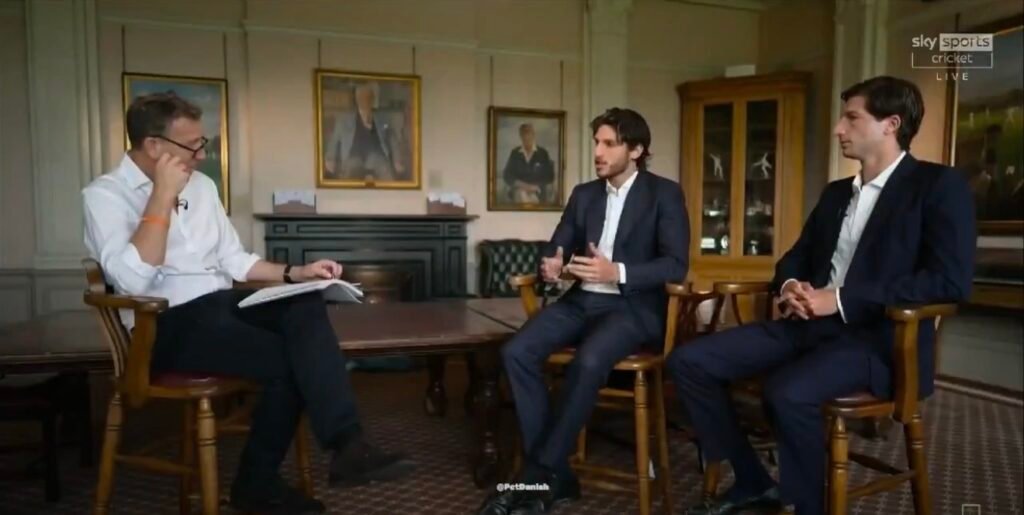
The Pakistan Cricket Board (PCB) formally complained to Sky Sports, and reports citing ESPNcricinfo said the board considered the extraordinary possibility of Pakistan’s players not returning to the field in protest. Pakistan ultimately resumed play.
But why did this become such a serious issue?
Because millions of viewers had tuned in to watch Pakistan play cricket at Lord’s. Instead, during one of the most visible windows of an international Test match, viewers were presented with an interview dominated by a highly contentious political dispute surrounding Pakistan’s former prime minister.
And that raises a very simple question:
Would the same editorial decision have been made if the political controversy involved another country?
Where is the precedent?
Has Sky Sports previously used the lunch interval of a major international Test to broadcast an extended interview with the relatives of a political figure about that country’s internal political affairs?
If there is a precedent, it should be explained.
If there is not, then the PCB is entitled to question the editorial judgment.
Cricket cannot become a political microphone
Let us be clear: the sons of Imran Khan have every right to speak about their father and express their concerns. Their allegations and fears should be reported where newsworthy.
But there is a difference between reporting a political story through a news programme and placing an 18-minute politically charged interview in the middle of an international cricket broadcast.
That distinction matters.
Cricket has always carried enormous emotional weight in Pakistan. It is one of the few things capable of bringing people together across political, social and geographical divisions.
Pakistanis watching their national team at Lord’s should not have to wonder whether the cricket broadcast has suddenly become another platform for Pakistan’s political battles.
And then comes the question of the Pakistan visit
Another part of this controversy concerns claims surrounding Imran Khan’s sons and their ability to travel to Pakistan.
Pakistan’s Information Minister Attaullah Tarar publicly stated in March that Suleiman and Kasim were welcome to visit Pakistan using their NICOPs as Pakistani citizens and that no visa was required, subject to compliance with Pakistani law.
That is an important fact that deserves to be part of the conversation.
It does not, by itself, settle every dispute about their circumstances or their ability to meet their father. Nor should allegations made by either side automatically be presented as proven facts.
But it does raise a legitimate question:
If the stated objective is to visit their father, why has the debate become so heavily centred on Western media platforms rather than on the practical question of travelling to Pakistan under the conditions set out by the Pakistani authorities?
That is a question for the individuals involved and for the authorities and it deserves evidence rather than political slogans.
Pakistan deserves fair treatment
The PCB’s reaction should not simply be dismissed as an attempt to silence criticism.
The board has a responsibility to protect Pakistan cricket’s interests and to ensure that international sporting events are not unnecessarily dragged into political disputes.
At the same time, broadcasters have a responsibility to maintain editorial independence while ensuring appropriate context and fairness.
This is not about asking journalists to remain silent.
It is about asking whether sport is the appropriate place for political campaigning.
And frankly, this is where many ordinary Pakistani cricket fans are angry.
They want to watch Babar Azam and the Pakistan team compete. They want to celebrate wickets, boundaries and victories. They want Lord’s to be remembered for cricket not for another political confrontation.
Pakistan’s image matters
Pakistan has spent decades contributing extraordinary talent to international cricket. From the legendary 1992 World Cup victory to generations of fast bowlers, batsmen and match-winners, Pakistan has earned its place in the history of the sport.
That legacy should not be reduced to a political headline.
If there are genuine concerns about the treatment, health or legal circumstances of any individual, those matters deserve serious journalism, evidence and scrutiny.
But international cricket should not become the stage on which one side of a political dispute receives an enormous platform while millions of sports viewers are effectively drawn into that dispute.
The question Sky Sports must answer
This controversy leaves Sky Sports with a very straightforward question:
Why was this particular political interview broadcast during the lunch interval of a Pakistan–England Test at Lord’s?
Was it because it was genuinely relevant to the sporting audience?
Was it because of the global significance of Imran Khan?
Or was the broadcaster simply exercising editorial judgment that, in this case, failed to recognise how deeply political and contentious the subject matter was?
These questions deserve answers.
Pakistan is not asking for special treatment.
Pakistan is asking for fairness.
And the PCB is right to raise the question of where the line should be drawn between journalism, politics and sport.
Because once politics enters the cricket field, it becomes very difficult to keep it out.
Cricket should unite. Journalism should scrutinise. Politics should be debated in the political arena.
And Lord’s should remain a place where the biggest story is what happens between the wickets not what happens in a political campaign.